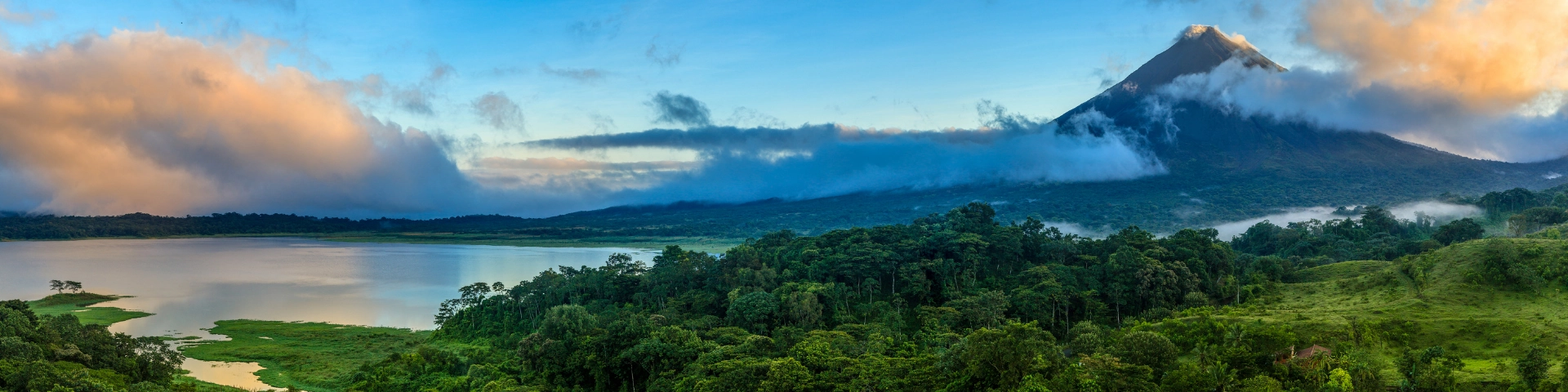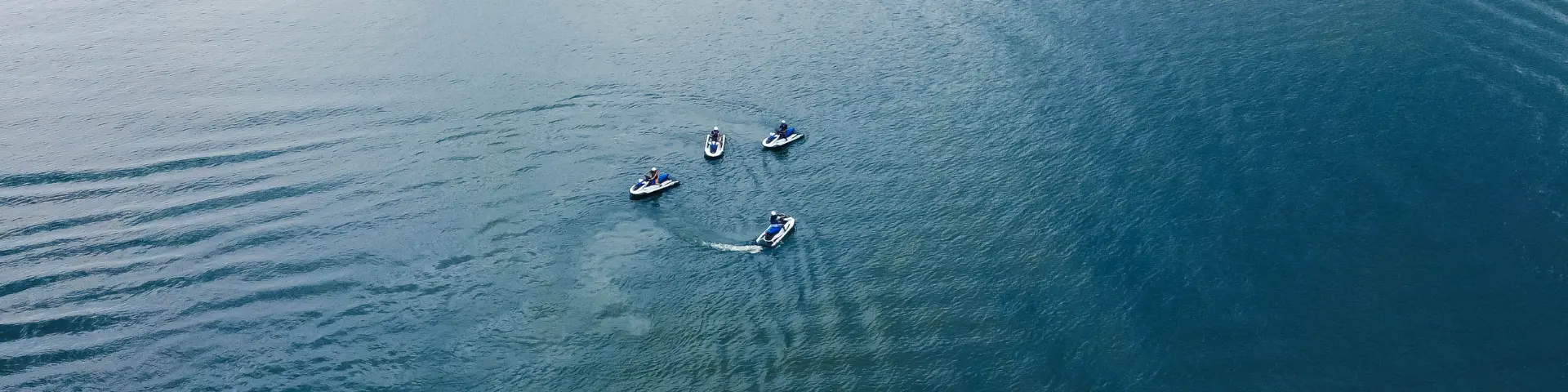
Lake Arenal Costa Rica is the largest lake in the country, and most travelers meet it through a car window on the drive into La Fortuna. It looks like a fjord: long, green at the edges, with the Arenal Volcano at one end. Then the questions start. Can you swim in it? Are there crocodiles? Is it worth a morning, or only a photo stop? Because we run the guided tours that leave from the lake and its southern shore, we field those questions daily. So here are straight answers: what the lake is, what lives in it, when the wind arrives, where to stay, and how to get there.
At a glance
- What it is: Costa Rica’s largest lake, and a working reservoir since 1979.
- Swimming: Not prohibited, but there are no lifeguards and the water runs cool.
- Crocodiles: Yes. Caimans and crocodiles have both been reported, mostly near the edges.
- Calmest water: Roughly May through November. December to April is windy.
- From La Fortuna: About 30 minutes by road to the dam and the El Castillo side.
What Is Lake Arenal Costa Rica, and Where Is It?
Lake Arenal is a man-made reservoir in the northern highlands, covering about 87 square kilometers and running roughly 30 kilometers end to end. It sits near 546 meters above sea level, between Tilarán and San Carlos. In practical terms, Lake Arenal Costa Rica starts about 30 minutes northwest of La Fortuna.
The Instituto Costarricense de Electricidad (ICE) created it by damming the Arenal valley at Sangregado. Filling began in September 1978, and the plant entered service on 9 December 1979. It still generates power, and its water also feeds irrigation canals in Guanacaste.
This is not only infrastructure, though. In 2000 the lake and its catchment became a Wetland of International Importance under the Ramsar Convention, a protected area of roughly 67,000 hectares.
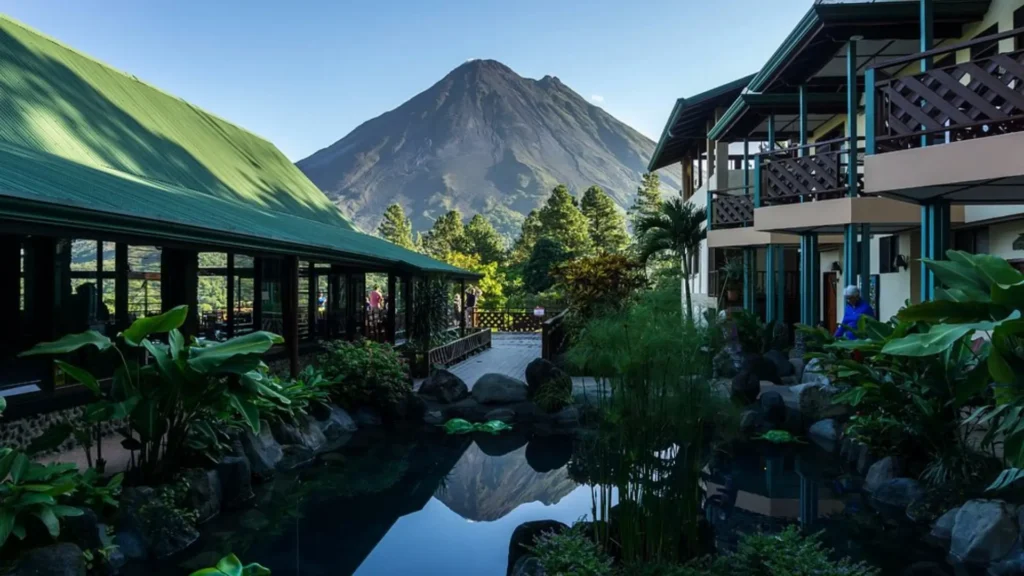
Good to know: the volcano stands at the eastern end. For that classic cone-over-water photograph, therefore, the south shore near El Castillo beats the north.
Can You Swim in Lake Arenal?
Yes, you can swim in Lake Arenal, and nothing prohibits it. Recreation, water sports, and fishing are all recognized uses of the reservoir. That said, this is not a supervised swimming lake. There are no lifeguards, no marked areas, and no roped shallows. Consequently, anyone who gets in is responsible for their own judgment.
Three things surprise people. First, the water runs colder than the Pacific or the Caribbean, because the lake sits more than 500 meters up. Second, conditions change fast; a calm bay turns choppy once the afternoon wind arrives. Third, the bottom is a flooded valley, with old fence lines, stumps, and sudden drop-offs.
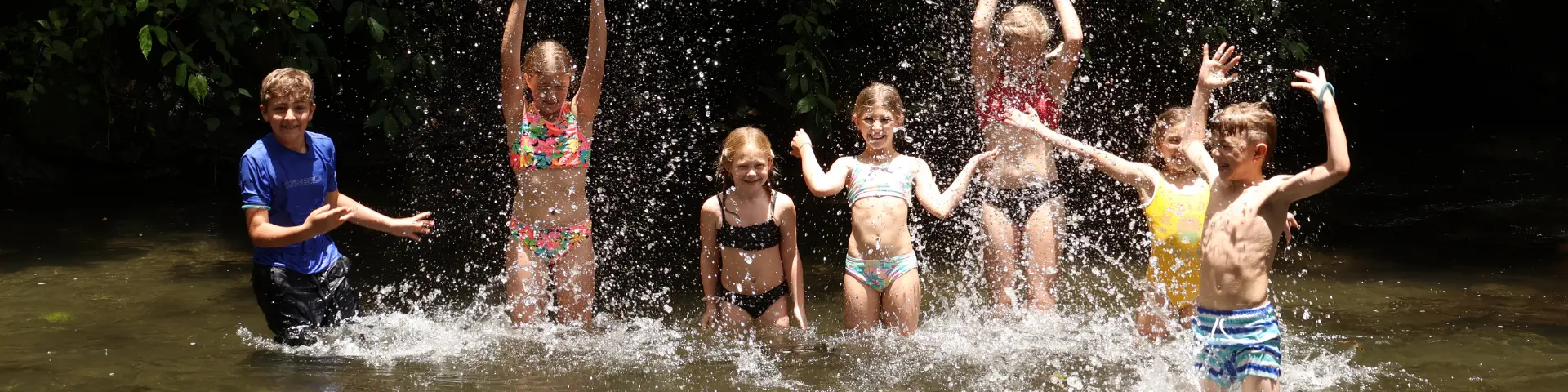
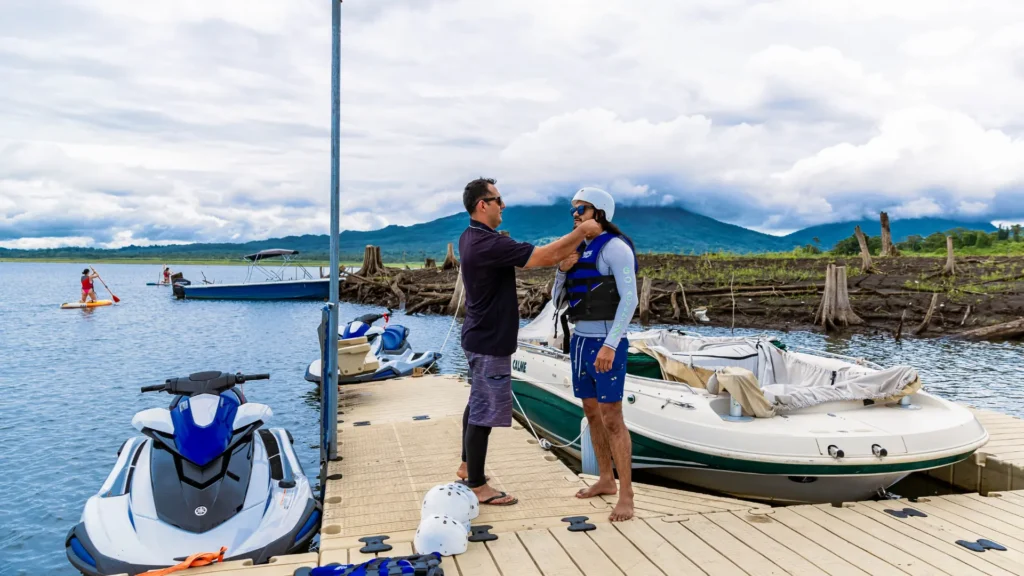
For that reason, swimming in Lake Arenal Costa Rica works best in the morning, in open bays, and with someone who knows the shoreline. Our own jet ski route includes an optional swim stop for exactly that reason: the guide picks the spot, not the guest.
In short: swimming here is legal and pleasant, but it is wild water, not a hotel pool.
Are There Crocodiles in Lake Arenal?
Yes, there are crocodiles in Lake Arenal, and caimans too. This is worth saying plainly, because many travel pages still claim otherwise. In January 2023, the administration of Arenal Volcano National Park confirmed that crocodile presence had been documented for roughly nine years. Caimans, they added, are seen easily around El Castillo de Peñas Blancas.
Costa Rica has two crocodilian species, according to national wildlife authorities: the American crocodile, which grows large, and the caiman or cuajipal, which stays smaller. Both prefer river mouths, inlets, and vegetated shallows. In other words, the risk sits at the edges of the lake rather than in the middle of it. Warning signs already mark several sectors.
Anyone planning to enter the water at Lake Arenal Costa Rica should follow the official guidance:
- Stay at least 50 meters back from the shore where presence has been reported.
- Never swim at a spot with a reported sighting, and check for signage first.
- Keep children and pets away from river mouths and vegetated banks.
- Never feed them, and never throw fish scraps into the water.
- Keep your distance instead of approaching for a photograph.
Costa Rica’s wildlife authorities also publish detailed guidance on coexisting with crocodiles and caimans, worth two minutes before any trip involving fresh water.
The honest version: sightings happen, they are localized, and the question is where you swim, not whether you visit.
The Story of the Lake: The Towns Underneath
Two whole towns lie under Lake Arenal Costa Rica. Before the dam, this valley held the communities of Arenal and Tronadora, plus several smaller settlements. Around 2,500 people were moved before the water rose, and everything below the 550 meter line was expropriated.
New villages went up on higher ground: Nuevo Arenal to the northeast, and a new Tronadora closer to Tilarán. Specialists still study the move as one of the better handled resettlements in hydroelectric history. For the families, though, it meant leaving houses, schools, and cemeteries behind.
The valley has not vanished completely, though. During dry years, when the reservoir drops, foundations and gravestones from old Arenal reappear along the shore. Locals photograph them. Then the water returns, and the village goes under again.
El Castillo, on the southern shore, carries the other half of the story. It grew after the 1968 eruption reshaped the region, and today it lives almost entirely from tourism. In April 2026 the community opened a bridge over the Caño Negro river, connecting it toward Monteverde after some 50 years of waiting.
Weather and Wind: Why Lake Arenal Is Different
Wind is the detail that catches first-time visitors to Lake Arenal Costa Rica off guard. From roughly December through April, northeast trade winds funnel through a gap in the Cordillera de Tilarán and accelerate across open water. The western end has drawn windsurfers and kitesurfers since the early 1990s for that reason.
Mornings are usually the calm window. Afternoons build, and by mid-afternoon in windy months the lake carries real chop. So if you want flat water, book early. For wind, the western end near Tilarán is where it lands hardest.
Rain follows different logic here than on the coast. The lake makes its own weather, and the volcano spends much of the year wrapped in clouds. Early morning is generally your best chance of a clear cone.
Expert tip: put lake activities before noon and land activities after. It is the easiest way to improve a day around Arenal.
Where to Stay Near Lake Arenal
Most travelers searching for hotels near Lake Arenal Costa Rica are really asking something else: which side of the lake should I sleep on? That answer matters more than the property itself, because the lake is long, the road around it is slow, and the two shores feel like different places.
The El Castillo side (south shore). Quiet, green, and the closest lake access to La Fortuna, roughly 30 minutes away. Volcano and lake views come standard. The trade-off is gravel road in sections and few restaurants after dark.
Arenal Observatory Lodge & Trails. Built in 1987 as a Smithsonian research station, it is still the only lodge inside Arenal Volcano National Park. Around 870 acres of forest and private trails, with volcano and lake views from the restaurant.
Rancho Margot. A self-sufficient eco lodge and working farm on the El Castillo road, built around its own food production, yoga, and farm tours.
Nepenthe B&B. A small hillside property above the water, with a pool, a restaurant, and unusually good birding from the terrace.
Hotel Linda Vista, Villas Paradise, and Arenal Vista Lodge. Three straightforward El Castillo options with volcano and lake views, across different budgets.
The Nuevo Arenal side (north shore). Rural, with German and Italian bakeries and long lake views from Route 142. It suits a slow night between La Fortuna and Guanacaste, although it sits about an hour from town.
La Fortuna itself. The most services, the widest hotel range, and the simplest logistics. You just will not wake up to a lake view.
Good to know: pick-ups from properties outside La Fortuna, including El Castillo, may carry an extra transport charge with most operators, ours included.
Things to Do On and Around Lake Arenal
There is more to do around Lake Arenal Costa Rica than pull over for a photograph. The water supports jet skis, boat trips, and sport fishing, while the shoreline carries trails, viewpoints, and hot springs. Because the lake is so long, most visitors pick one sector rather than circling the whole thing.
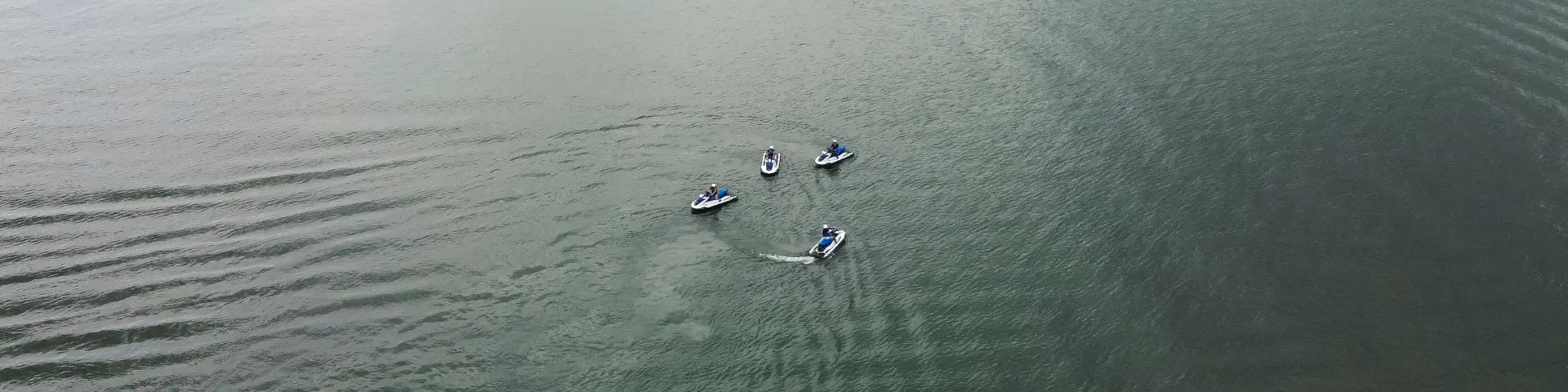
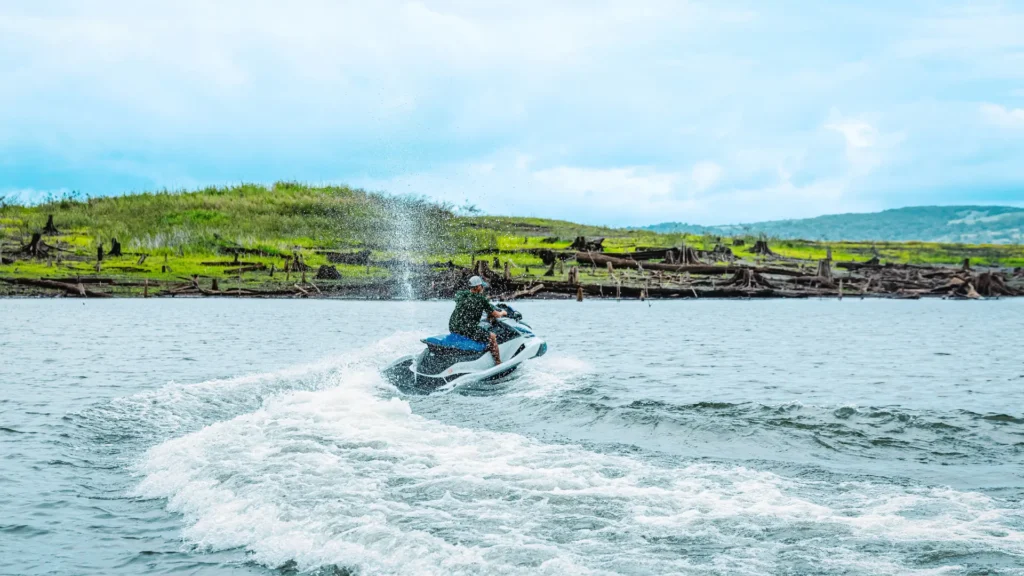
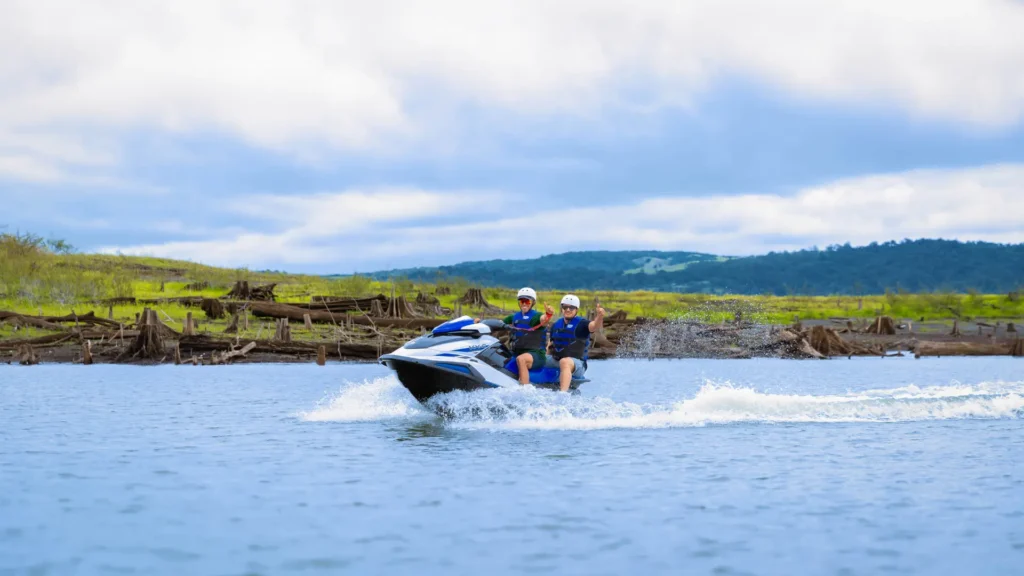
- Out on the water. A guided ride is the fastest way to grasp the scale of the reservoir. Our jet ski tour on Lake Arenal runs about 90 minutes, with one guide for every five guests and an optional swim stop. Children from age five ride as passengers. For a first time out, we also wrote what to know before you ride the lake.
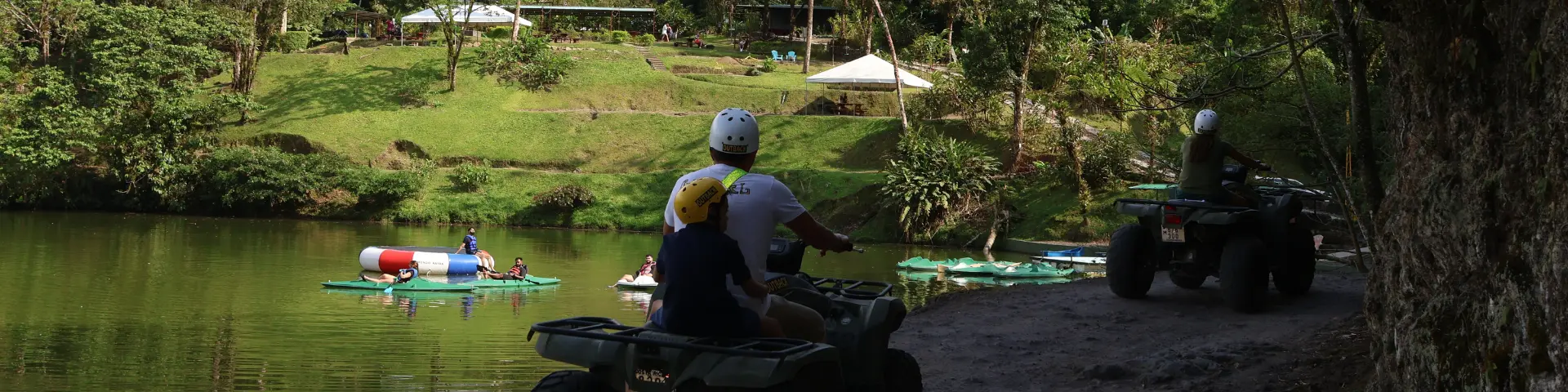
- Lakeside trails and river crossings. From the El Castillo base, our ATV route along the lakeside trails runs two hours through rural landscape and clear rivers, finishing in hot springs with entrance included. Drivers need a valid license, while passengers from age five are welcome.
- The same route, more comfort. The Side by Side version of that ride has a steering wheel, seatbelts, and a shared cabin, so it works for travelers with limited mobility.
- Boat trips and fishing. Independent operators run lake cruises and guapote fishing charters from several points around the shore. Neither is part of what we offer, yet both belong to the lake.
- Viewpoints and the dam. Route 142 crosses the Sangregado dam, then curls along the northern shore past pull-offs where the volcano lines up behind the water.
Prefer to stay closer to town? Instead, trails on the La Fortuna side of the volcano run through rainforest, river crossings, and the Maleku Indigenous community.
How to Get to Lake Arenal from La Fortuna
Getting to Lake Arenal Costa Rica from La Fortuna is simple. Head west on Route 142, and you reach the dam and the first open water in about 30 minutes. Nuevo Arenal sits roughly an hour out, while Tilarán, at the far western end, takes about 90 minutes. The road is paved the whole way.
El Castillo lies on a signed turnoff south of the dam, also around 30 minutes from town, although the last stretch is gravel. Standard cars manage it in normal conditions. After heavy rain, however, take it slowly.
Two practical notes. Route 142 curves for most of its length, so allow more time than the distance suggests. Roads on the far southern shore stay unpaved and do not connect all the way around, so do not trust a shortcut your map app offers.
If you would rather not drive, our lake tours include round-trip transport within the La Fortuna zone.
Frequently Asked Questions
Yes. Swimming is not prohibited anywhere on the lake, and the water is fresh and clean. There are no lifeguards or marked swimming areas, however, so choose open bays, go in the morning, and avoid river mouths and heavily vegetated shallows.
Yes. Both caimans and crocodiles have been documented here, and national park staff have confirmed their presence publicly. Sightings cluster near river mouths and inlets rather than in open water, and signage marks several sectors of the shore.
It is safe enough that guided tours include optional swim stops, provided you use judgment. Swim with others, stay away from vegetated banks, respect posted signage, and never enter where a sighting has been reported.
About 30 minutes by car to the dam and the El Castillo turnoff, on paved Route 142. Nuevo Arenal is roughly an hour away, while Tilarán takes about 90 minutes.
Morning. Water is calmest before noon, wind builds through the afternoon between December and April, and the volcano is most likely to be clear shortly after sunrise.
Yes, if you give it more than a pull-off. Between the water, the towns beneath it, and the quiet villages on the south side, the lake rewards half a day.
Planning Your Time on the Lake
Lake Arenal Costa Rica is easy to underestimate from the road. It is a reservoir with two towns beneath it, a wind season that shapes the region, and a quiet southern shore. Understanding those three things is most of the planning.
So if you are still shaping your days around Arenal, start early, while the water is flat and the volcano is clear. Take a look at what runs on the lake and along its shore, or write to us and tell us who is traveling with you. We will honestly say which side of the lake fits your trip, even when the answer is not a tour.
Still deciding how to spend your days in town?
Our guide to things to do in La Fortuna covers the rest of the region.